SNUG Showcases Bio-Based Construction Synergies Alongside Sister EU Projects at Maderalia
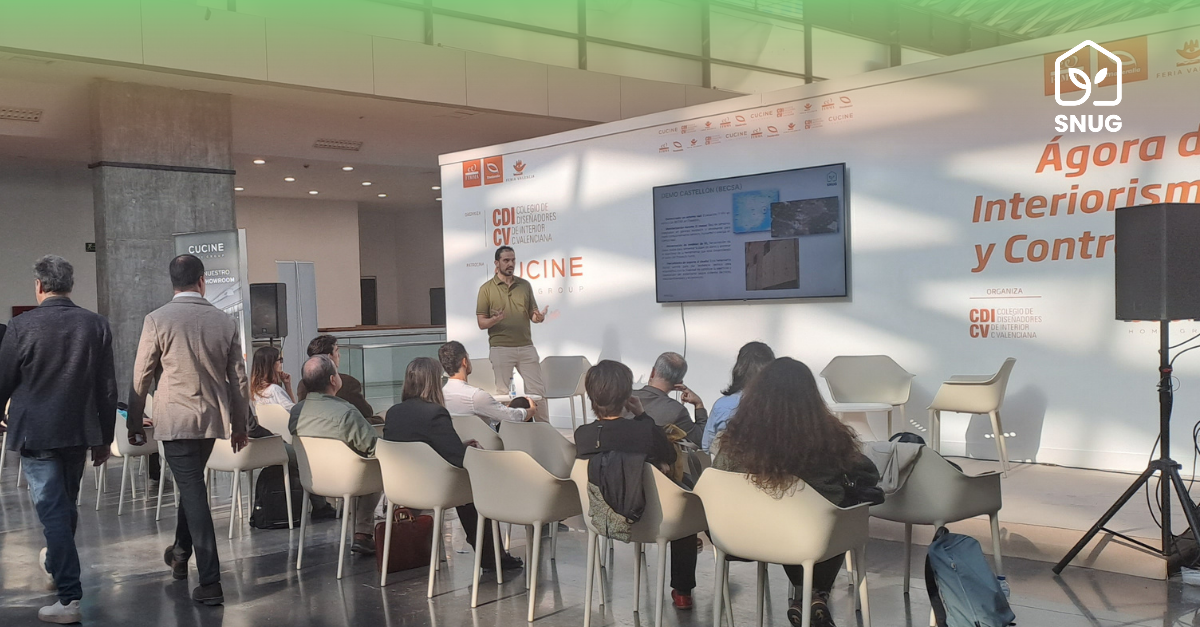
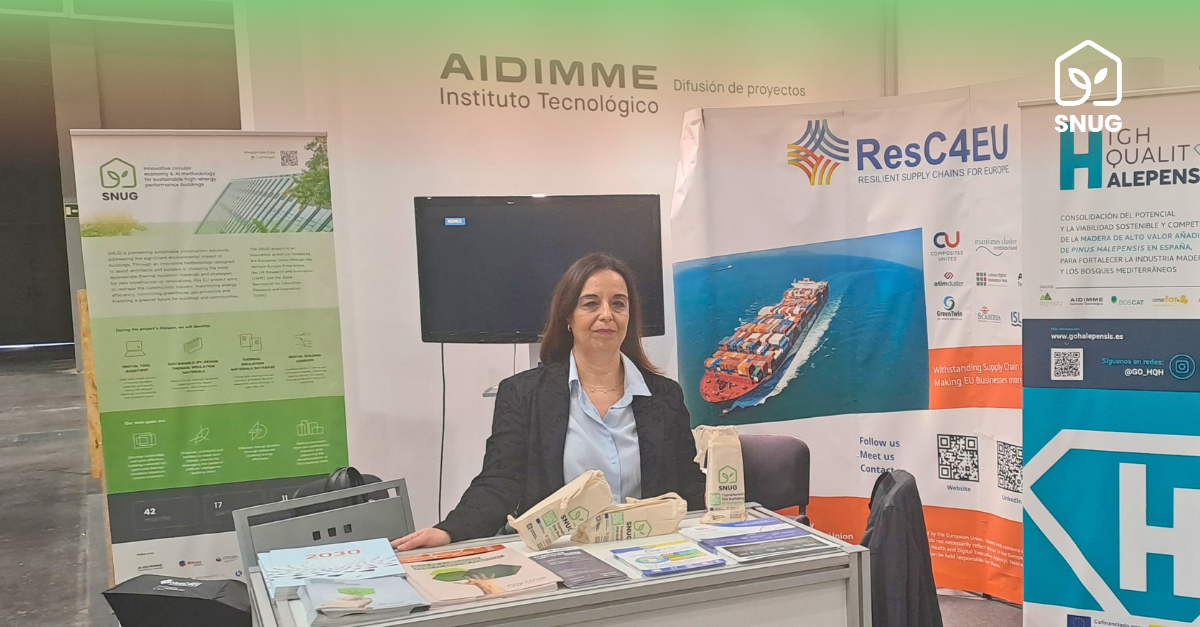
As part of our mission to drive cost-optimal, ultra-energy-efficient buildings through circularity and AI, the SNUG project recently took center stage at FIMMA + Maderalia in Valencia. Coordinated by our partners at AIDIMME, SNUG joined forces with three fellow EU-funded initiatives – HARWASTING, SUSPENSE, and DeCO2 – for a dedicated joint seminar highlighting how bio-based materials and waste valorization are actively reshaping the future of sustainable construction.
Four European Projects, One Shared Challenge: Building with Bio-Based Materials to Advance Toward More Sustainable, Circular, and Low-Carbon Construction
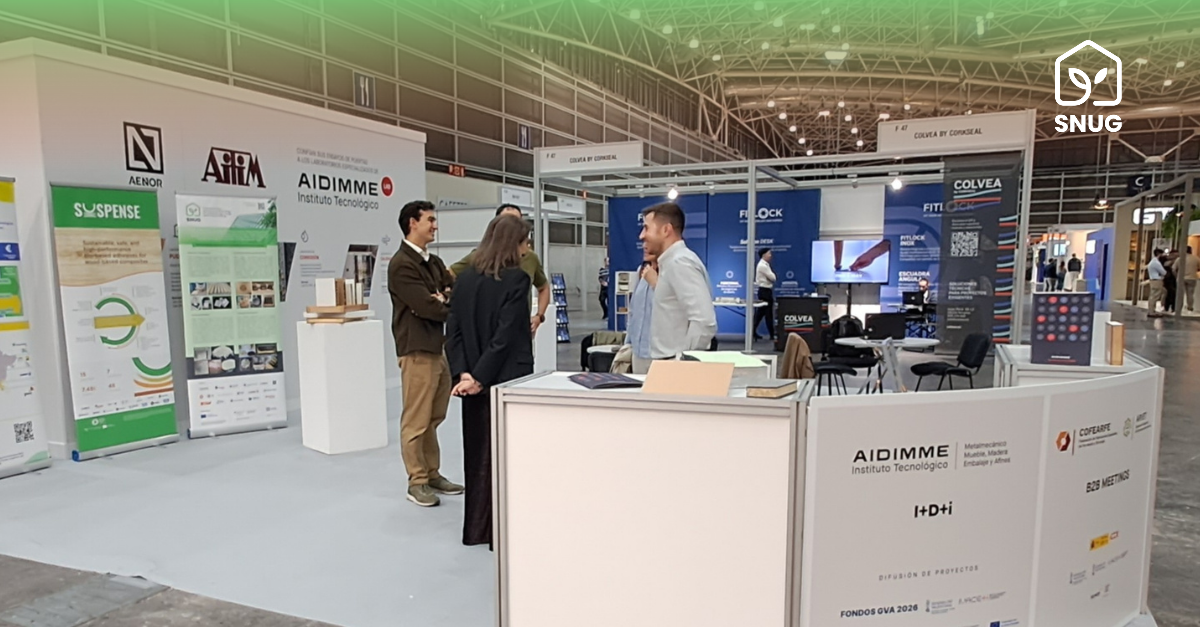
Held from November 10 to 13 at Feria Valencia as part of FIMMA + Maderalia, Maderalia closed its 41st edition by solidifying its position as one of the leading meeting points for the wood, furniture, and construction industries. The trade fair brought together nearly 30,000 professionals from over 70 countries and featured 921 exhibiting companies and brands from 28 countries, spread across six pavilions and more than 72,000 m² of exhibition space.
Against this backdrop, AIDIMME took the opportunity to introduce the sector to several European initiatives it is working on to drive more sustainable construction. Researchers Dr. Alicia Marco, Juan Carlos Guerrero, and Nicolás Santamaría presented four European projects that – while tackling distinct technological challenges – share a common vision: incorporating bio-based materials, transforming waste into new resources, and developing innovative building solutions whose viability is proven in real-world applications and environments.
SNUG
SNUG is developing a methodology rooted in the circular economy and artificial intelligence to promote cost-optimal, ultra-energy-efficient, and sustainable buildings. Coordinated by AIDIMME, the project brings together 16 partners from 11 countries with a budget of €5.5 million. Throughout the project, researchers are developing various types of sustainable materials that enhance a building’s energy efficiency through thermal insulation or energy storage-and-release capabilities.
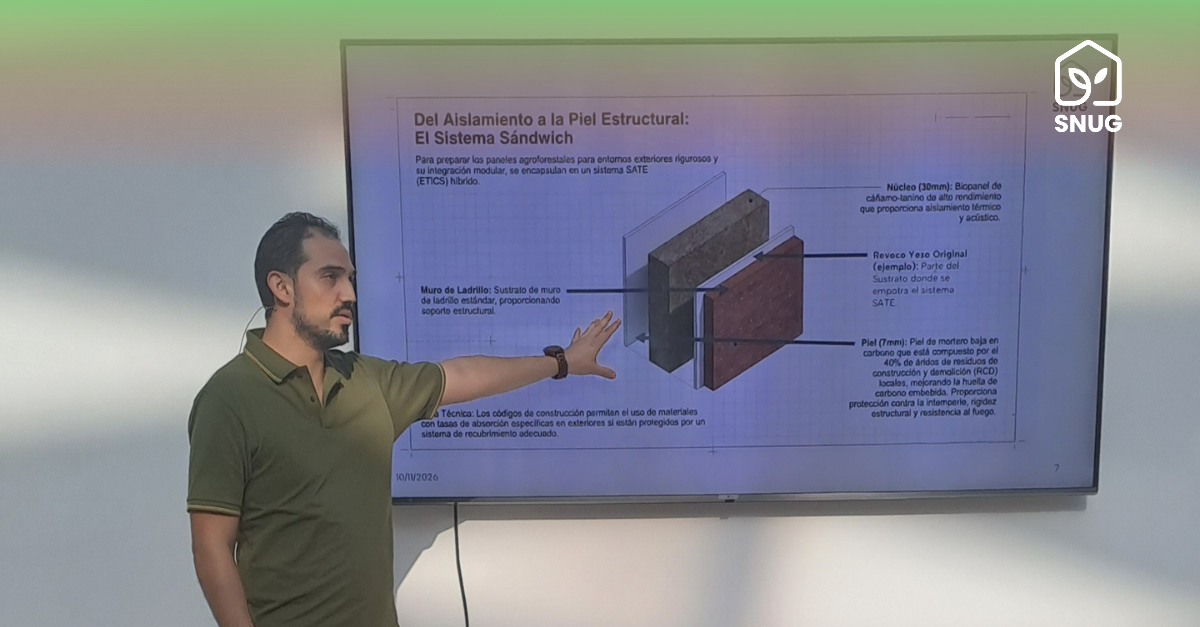
The initiative will establish at least three demonstrator sites in buildings with varying characteristics, uses, and climates. One demonstrator will be located at an office building in Castellón, where two building solutions will be installed: sustainable aerated concrete blocks and an External Thermal Insulation Composite System (ETICS) based on sandwich panels made from hemp biopanels and bio-adhesive, finished with an outer layer of sustainable mortar. The building will be monitored before and after installation to evaluate energy savings. The resulting data will feed into an AI-based digital support tool designed to identify the most suitable thermal insulation solutions and layouts for any given building based on its technical specifications, location, and use, weighing technical, environmental, and cost parameters. AIDIMME is directly involved in developing the sandwich panels, as well as evaluating and monitoring them at the Spanish demonstrator site.
HARWASTING
HARWASTING upcycles forestry and agricultural biomass, pruning waste, and by-products from the bioethanol and olive oil industries to boost the rural bioeconomy. Coordinated by AIDIMME, the project unites 16 partners from 7 countries and has a budget of €4.9 million.
The project relies on two waste-treatment technologies:
- Pressurized hot water extraction is used to obtain tannins and lignins, which are subsequently treated to improve their reactivity and formulate bio-adhesives for wood-based panels.
- Hydrothermal carbonization (HTC) produces hydrochar.
Together, these outputs are used to manufacture hybrid wood-and-hydrochar panels designed for applications such as fire protection and electromagnetic shielding. AIDIMME is leading the formulation, scaling up (in MDF and particleboard panels), and characterization of these materials.
SUSPENSE
SUSPENSE develops more cost-effective and sustainable alternatives that improve material recyclability, cut CO₂ emissions, and reduce health risks while promoting resource efficiency. To achieve this, the project collaborates across the entire value chain to accelerate the development and market uptake of bio-based adhesives for manufacturing wood-based panels and insulation materials.
With a budget of €7.48 million and 15 partners from 7 countries, SUSPENSE creates safe, high-performance, 100% bio-based adhesives as alternatives to fossil-derived options containing formaldehyde and isocyanates. Developed via two chemical pathways – acids and polyphenols – these adhesives target applications in construction and furniture. AIDIMME contributes to the evaluation phase by conducting mechanical, thermal, acoustic, and fire-reaction testing, studying recycled fibers, and verifying overall safety and sustainability.
DecO2
DeCO2 aims to transform the construction industry into a more sustainable, lower-emission sector by combining new technologies, sustainable materials, corporate collaboration, and citizen engagement across three demonstrator sites in different European countries. The project involves 17 partners from 8 European countries and operates on a €7 million budget.
In the Spanish demonstrator, bio-based solutions are being applied through two complementary initiatives:
- Renovation of the Municipal Library of Castellón de la Plana: This intervention aims to boost energy efficiency by over 30% and recycle 70% of construction waste.
- Monitoring in Paterna: Researchers are evaluating five 2 m² modules installed on the east facade of an all-timber building constructed by AIDIMME in collaboration with the Valencian Institute of Building (IVE) and students from the Universitat Politècnica de València (UPV) through the Maderamen Chair. These modules incorporate biopanels made from hemp, rice husks, recycled wood, and cork, coated with a plant-based mortar.
Additionally, AIDIMME is testing oriented strand boards (OSB) manufactured using recycled wood shavings and natural tannin resins.
A Shared Roadmap Toward Circular Construction
Through projects like SNUG, HARWASTING, SUSPENSE, and DeCO2, the consortium partners – led in these initiatives by AIDIMME – are steering the construction industry toward a more sustainable, circular, efficient, and low-emission model. This collective work spans the entire value chain: from valorizing agricultural, forestry, and industrial waste and developing new bio-based raw materials, to formulating, manufacturing, characterizing, and validating innovative building materials and solutions.
These initiatives yield more sustainable alternatives to conventional materials, improve building performance and energy efficiency, reduce environmental impact, and encourage the use of renewable and recycled resources. Furthermore, by participating in real-world demonstrators and developing digital tools, these collaborations facilitate the transfer of research results to industry and their eventual market adoption – accelerating the transition toward European circular economy and climate neutrality goals.