From Circular Materials to Workforce Inclusivity: SNUG Consortium Takes the Stage at ReSBE 2026
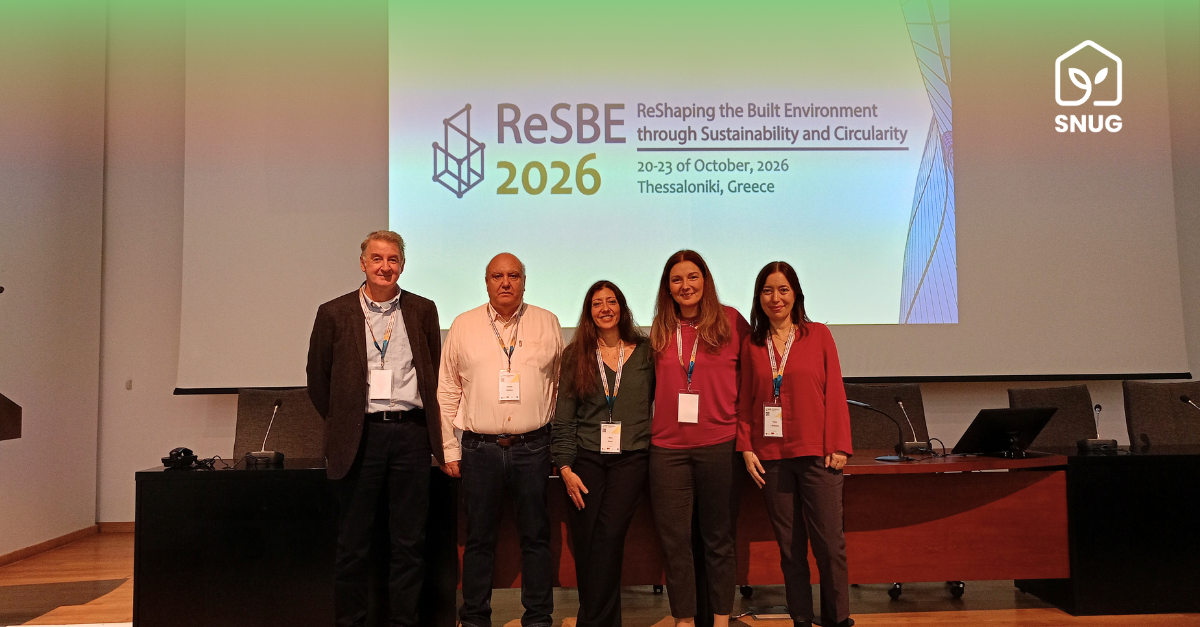
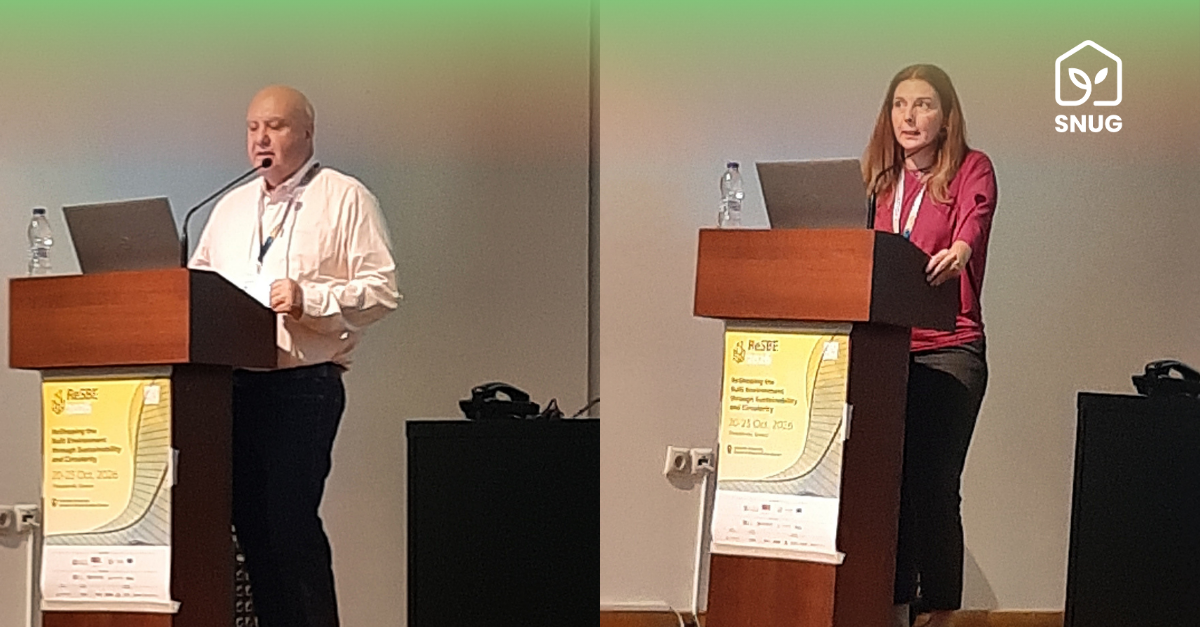
On October 20 in Thessaloniki, the SNUG project took center stage at ReSBE 2026 (ReShaping the Built Environment through Sustainability and Circularity). During a packed Session I.3.A, partners demonstrated how the transition to zero-emission buildings spans every dimension of the built environment – from circular, bio-based materials and lifecycle assessment to ergonomic inclusivity, digital simulations, and societal readiness.
Key contributions presented by the consortium, with significant leadership from the Centre for Renewable Energy Sources and Saving (CRES) and Kastamonu Entegre (KEAS), demonstrated this holistic vision across technical, environmental, and social frontiers.
Advancing Next-Generation Materials & Zero-Emission Performance
Buildings account for roughly 40% of the European Union’s energy demand and 35% of its waste generation. To directly address these figures, the consortium showcased practical approaches for integrating high-performance, low-carbon solutions into real-world structures.
Sustainable Insulation for Zero-Emission Buildings (ZEBs)
Led by CRES alongside AIDIMME and Lurtis AI, this paper presented a comprehensive assessment methodology evaluating energy efficiency, carbon emission abatement, and operational comfort. Using virtual energy simulations on a real-case central European building, the study illustrates how circular, low-carbon insulation configurations achieve deep decarbonization while directly improving indoor environmental quality.
[Presentation] [Zenodo]
LCA & Recycling Potential of Wood-Based Panels
Drawing on the industrial expertise of Kastamonu Entegre (KEAS), this systematic PRISMA-based review (Springer – Lecture Notes in Civil Engineering) evaluated 22 peer-reviewed studies across particleboard, MDF, OSB, and plywood. Findings revealed that Medium-Density Fiberboard (MDF) carries the highest carbon footprint (~500–600 kg CO₂e/m³) due to energy-intensive refining and drying, while OSB (190–220 kg CO₂e/m³) and plywood (100–150 kg CO₂e/m³) demonstrate significantly lower impacts. The authors identified adhesive formulation and thermal drying as primary environmental hotspots, proving that cascading wood utilization and closed-loop recycling are essential to decarbonize Europe’s annual 366 million m³ panel output.
[Zenodo]
Redefining the Building Site: Ergonomics & Workforce Inclusivity
A distinct hallmark of the SNUG approach presented at ReSBE 2026 is connecting material engineering directly to workforce sustainability and job equity.
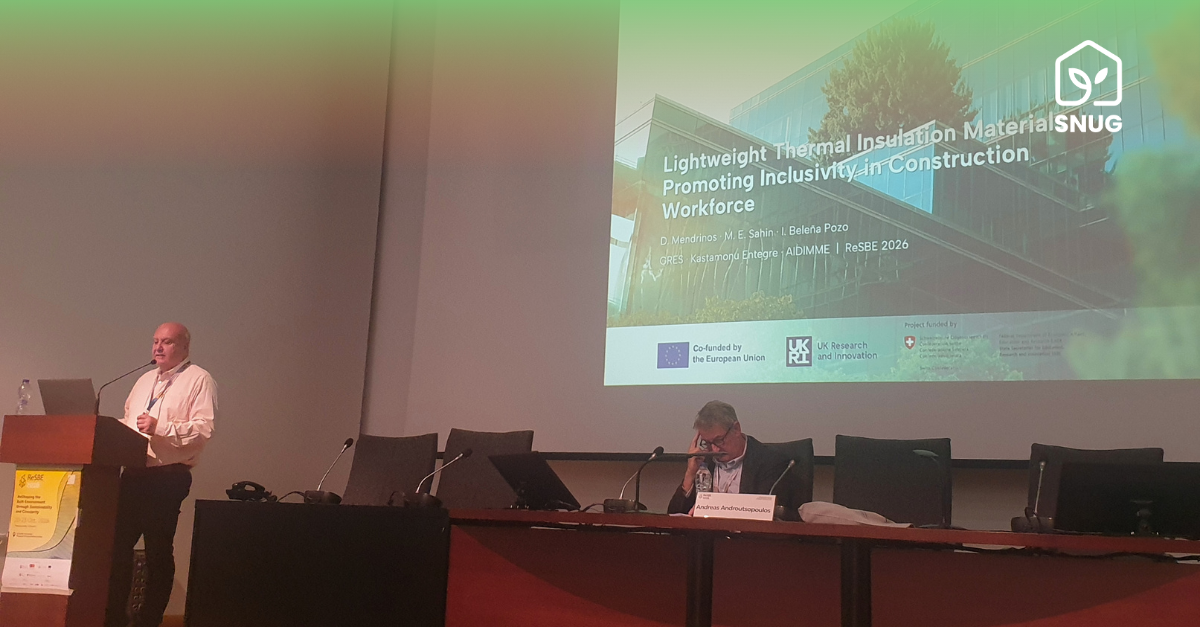
Lightweight Thermal Insulation Promoting Inclusivity
A joint investigation by CRES, Kastamonu Entegre, and AIDIMME analyzed four flagship innovations: aerated eco-concrete blocks, self-leveling PCM mortars, aerogel-based plasters, and bio-based hemp fiber panels. By substantially reducing material deadweight, these systems lower physical strain and pivot on-site demands away from brute force toward technical precision, digital equipment operation, and skilled craftsmanship – opening construction trades to a broader, multi-generational, and gender-inclusive workforce.
[Presentation] [Zenodo]
Integrating Gender Dimensions into Simulation Tools & Material Design
CRES and AIDIMME introduced a three-tier framework (structural, analytical, translational) that systematically accounts for gender across the project lifecycle. This work connects lightweight, modular assemblies on-site with documented occupant priorities, ensuring that high-performance insulation directly targets female sensitivity to thermal comfort and indoor air quality.
[Presentation] [Zenodo]
Societal Alignment & Market Readiness
Technical breakthroughs achieve true impact only when embraced by the market. Session I.3.A highlighted critical empirical research bridging lab innovations with industry and consumer adoption:
What Stakeholders Truly Expect from Innovative Building Solutions
Authored by CRES, CTCON, and AIDIMME, this study (Springer – Lecture Notes in Civil Engineering) surveyed 115 end-users across 12 European countries with manufacturer validation. The data revealed a functional decision hierarchy: technical factors rank highest, followed by economic, environmental, and social criteria. Users prioritize durability, moisture resistance, and health over green branding alone. Critically, higher-knowledge respondents showed a significantly greater willingness to adopt sustainable criteria, underscoring that targeted education and regulatory standards are vital to bridging Europe’s “sustainability gap.”
[Presentation] [Zenodo]
Driving Systemic Change Across the Built Environment
Session I.3.A underscored that high-performance buildings cannot be solved solely through material formulation. Real decarbonization requires aligning material durability, lifecycle carbon metrics, digital design tools, and inclusive labor practices with the functional expectations of builders and occupants alike.
The SNUG consortium extends its appreciation to all authors and presenting partners from CRES, Kastamonu Entegre, AIDIMME, CTCON, and Lurtis AI for driving these discussions at ReSBE 2026.